
Enabling EUV mask inspection with CNT debris filters in advanced semiconductor manufacturing
As semiconductor manufacturing advances to smaller technology nodes, EUV mask inspection has become critical for detecting nanoscale defects that can affect millions of chips. At the same time, EUV light generation introduces particles that threaten mask integrity and inspection accuracy. Debris filters are therefore a key enabler, and carbon nanotube (CNT) membranes, with their unique combination of high EUV transmission and durability, have emerged as a leading solution for reliable EUV inspection.
Extreme ultraviolet lithography (EUVL) has enabled the semiconductor industry to move to advanced nodes at 7 nm, 5 nm, and below, increasing transistor density and overall performance of integrated circuits (ICs) or chips. Reticles (also called photomasks or masks) are precision templates used to transfer circuit designs onto silicon wafers during EUVL, which are then cut into chips. Any single defect on a mask may replicate on entire wafer batches – and on millions of chips, resulting in significant yield losses and production costs. Therefore, mask defect inspection has become a critical quality-control step in advanced chip manufacturing, requiring extremely high accuracy and defect sensitivity.
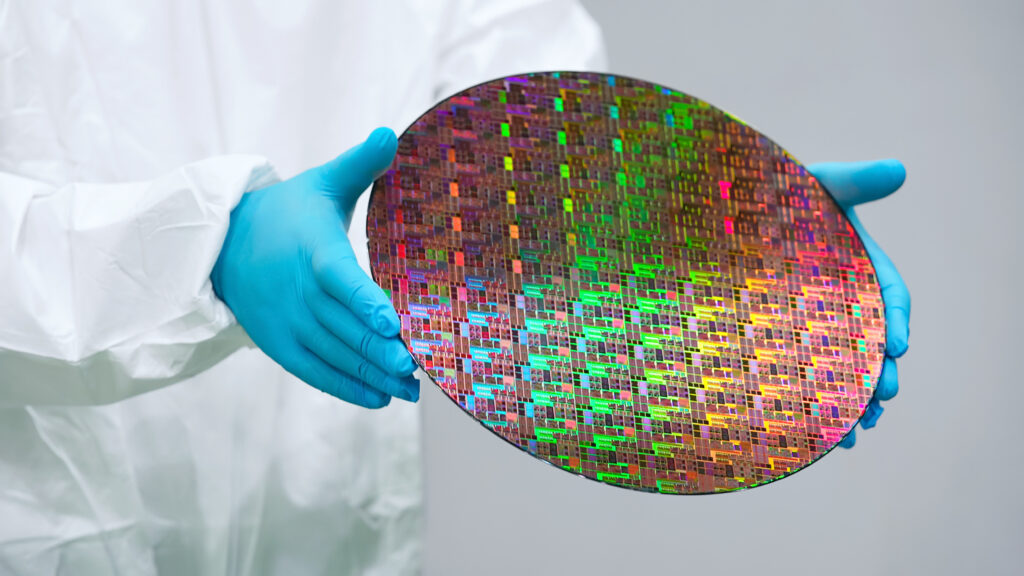
The transition to EUVL has similarly shrunk feature sizes on photomasks and increased complexity in their design, raising the requirements for their inspection. Today’s reticles must be inspected at EUV wavelengths to ensure the required level of accuracy. However, using the EUV during inspection introduces a new challenge. In laser-produced plasma EUV sources, debris and particles generated during plasma formation threaten to contaminate photomasks and sensitive optics.
To avoid contaminating the reticle and optics during the inspection process, debris filters have become a critical enabler for today’s EUV mask inspection tools, where contamination from EUV light sources threatens to compromise mask integrity, optics and measurement accuracy. In this demanding EUV environment, carbon nanotube membranes stand out as the key material for debris filtering, as they combine high EUV transmission with effective particle blocking and mechanical durability.
Dr. Thomas Gädda, CPO, Semiconductor BU, Canatu
In this article, Dr. Thomas Gädda, CPO of Semiconductor business unit at Canatu, tells how debris filters made of advanced carbon nanotube (CNT) membranes are making modern EUV mask inspection possible and why CNT is the primed material for this challenge.
How EUV lithography changed mask inspection

Over the past decades, photolithography has evolved from deep ultraviolet (DUV) technologies to extreme ultraviolet (EUV), enabling the semiconductor industry to reach advanced nodes at 7 nm, 5 nm, and below. With this transition, the complexity and value of photomasks have also increased substantially.
Today’s EUV masks are multilayered, highly sensitive structures with dense patterns of circuit designs. Moreover, each one of them is used for more batches of chips than previous generations. EUV masks differ from traditional masks as they are reflective, multilayer mirrors designed for 13.5 nm EUV light, while earlier generation masks (e.g., i-line, KrF, ArF) are transmissive and rely on light passing through. This shift in reticle architecture and sensitivity changed their inspection requirements.
The complexity and sensitivity of EUV masks and the criticality of their potential defects require the highest level of inspection accuracy. This can only be achieved with the actinic inspection method. Actinic inspection, or Actinic Patterned Mask Inspection (APMI), is a method where photomasks are inspected using the same wavelength of light that is used in the actual lithography process. In the case of EUV lithography, this means masks are inspected with 13.5 nm EUV radiation instead of longer wavelengths like DUV.
Besides the need for higher accuracy, the growing adoption of EUV pellicles made the actinic solution a required inspection method for mask qualification for pellicle mounted mask too. The composite materials presently used in EUVL are not transparent to the light used in previous generations of mask inspection tools. This further necessitates the use of actinic inspection of EUVL reticles unless the composite pellicle is removed prior to inspection. Pellicle removal for inspection is not desirable for a number of reasons. Multiple APMI systems have already been installed in mask inspection shops solely for pellicle inspection purposes.
The hidden side effect of EUV light production
Unlike conventional light sources, EUV radiation cannot be generated with lamps and must be produced inside the system under vacuum conditions. There are different types of EUV light sources, including discharge-produced plasma (DPP) and laser-produced plasma (LPP), but modern EUV lithography and inspection tools predominantly rely on tin-based laser-produced plasma sources because of their high efficiency at generating 13.5 nm EUV radiation.
In these systems, a high-power CO₂ laser is fired at microscopic droplets of molten tin (Sn), creating a plasma that emits EUV light. However, this process also generates byproducts: tin particles, droplets, and atoms that are ejected from the plasma at high speed. These contaminants, known as debris, can travel through the optical path and deposit on photomasks or sensitive optical components, directly affecting inspection accuracy and mask integrity.
To address this challenge, debris filters have become critical for the modern EUV inspection systems, blocking particles and protecting both the photomask and optical system while allowing EUV radiation to pass through.
Why debris filters are essential for EUV mask inspection quality
Debris filters are now an essential component within EUV inspection tools, where they may be integrated at multiple critical points. Typically, the filter is placed along the optical path for optimum performance. Other potential locations include in close proximity to the EUV light source or at the window of the inspection chamber. Their placement is designed to block particles to prevent them from reaching the photomask or other sensitive components within the system.
During EUV mask inspection, debris filters serve several critical functions:
- Block particles generated inside and outside the inspection system
They capture tin droplets and other byproducts from the EUV source, preventing potential contaminants from propagating through the system. - Maximize light intensity for improved inspection quality
Debris filters can minimize absorption and reflection, ensuring high intensity of light needed for improving analysis signal and decreasing analysis time. - Maintain stable imaging conditions for accurate defect detection
Clean optical paths are essential for high-sensitivity inspection, supporting consistent signal quality and reliable defect detection.
The complex conditions of the EUV environment require debris filters to meet specific parameters – they need to efficiently block particles and, at the same time, have high EUV transmission, low scattering, and durability under vacuum and thermal stress.
Carbon nanotube membranes have emerged as a leading material solution that delivers a combination of high optical transmittance, mechanical strength, and versatility that matches the needs of today’s mask inspection systems.
Carbon nanotubes are the primed material for debris filtering in EUV inspection tools
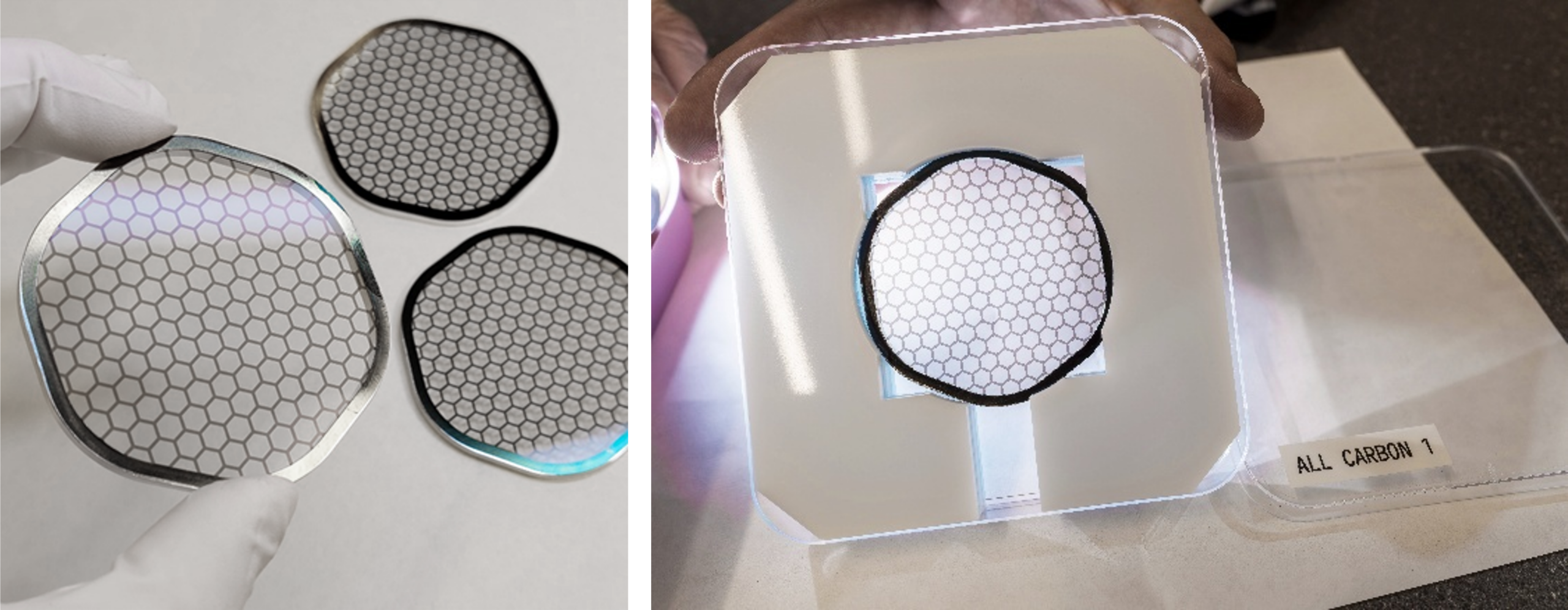
Carbon nanotubes (CNT) structure and material properties directly correspond to the needs of debris filters in the EUV environment. Due to their high EUV transmittance and mechanical durability in harsh conditions, CNT debris filters became the main solution for particle control in EUV mask inspection.
CNT filters combine high EUV transmission (up to 97%), low scattering, and strong mechanical durability. This allows them to block particles effectively without compromising inspection accuracy. Another key advantage is spectral control. CNT membranes can be coated to block unwanted wavelengths, such as DUV or infrared light. From a reliability standpoint, CNT filters are well-suited to harsh operating conditions. They can withstand high vacuum, pressure fluctuations, and thermal loads typical in EUV systems.
We have invested years of R&D, IP, and industrialization to create a quality product – and it has been in mass production since 2021. Debris filters support critical quality control processes in advanced chip manufacturing. Today, Canatu is a leading supplier of CNT debris filters for EUV mask inspection, and our proprietary CNT membrane technology is also rapidly being adopted for EUV pellicles.
Dr. Thomas Gädda, CPO, Semiconductor BU, Canatu
Debris filters made of CNT membranes are the key enabler of EUV mask inspection today by combining effective filtration, unmatched optical performance, and durability. Their adoption supports higher yield, better defect control, and more reliable inspection in the increasingly demanding environment of advanced semiconductor manufacturing.
Contact our specialist in CNT debris filters
