

Market environment
Canatu’s current focus markets—Semiconductors, Automotive, and Medical Diagnostics—are undergoing a technological transformation, creating demand for high-quality CNTs and offering Canatu potential for growth and profitability.
Semiconductor market
The rapid growth of AI is driving demand for advanced chips, making EUV lithography increasingly critical. Central to this is the adoption of ASML’s high-power EUV scanners, which is expected to require CNT pellicles to protect photomasks (reticles) from defects during chip fabrication. In the view of Canatu’s management, CNT pellicles are emerging as a key enabling technology, as traditional composite pellicles are expected to decrease their capabilities with the heat and stress of high-power EUV scanners. Deployment of 600W EUV scanners is now expected in 2027, and in the view of Canatu’s management, this is anticipated to mark a key inflection point for broader adoption of CNT pellicles.
Canatu’s proprietary direct Dry Deposition™ process enables the production of ultra-thin, highly uniform CNT pellicle membranes that outperform conventional composite pellicles, particularly in high-power scanners. These CNT pellicle membranes offer high transmission and durability, supporting productivity increase potential in the EUV lithography process by up to 8–15%.
Canatu does not currently produce ready CNT pellicles but provides its technology through the CNT reactor model. Canatu CNT 100 SEMI reactor is used to produce pellicle membranes, which undergo postprocessing and coating before being capable of being used as CNT pellicles in EUV lithography systems.
Canatu has received customer approval (Site Acceptance Test, SAT) for the first reactor it shipped to FST in 2024, and granted license for commercial production of CNT pellicle membranes. After Canatu has received SAT for its reactor, the customer must secure approval(s) for the complete coated CNT pellicle product before pilot and risk production. Third-party certification for safety and performance by ASML is required for CNT pellicle use in EUV scanners. After successful pilot and risk production, high-volume production of CNT pellicle membranes can commence. Mass production will generate Canatu revenue from consumables and sold CNT pellicles.
Canatu believes that its competitive market position has even improved compared to the situation at the time of its listing in September 2024 based on the significant progress with the existing reactor customers and discussions with new customers. Canatu is not aware of any other party having conducted CNT reactor sales for CNT pellicle membrane production in the semiconductor industry besides Canatu. The company is, in the ordinary course of its sales operations, engaged in discussions with potential new customers entering the market.
Estimated annual development of addressable CNT pellicles market (EURm)1)
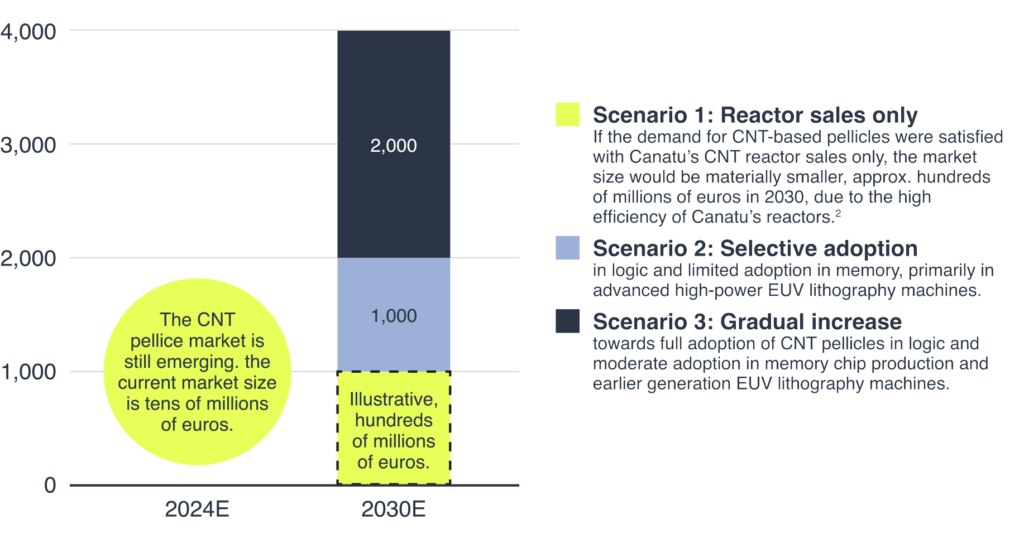
2) In such a scenario, recurring revenue elements such as the sale of non-discretionary consumables and royalties would potentially comprise a very large part of the market.
Canatu inspection membranes play an important role in enhancing quality control during pre-lithography processes. Specifically, they are currently used in patterned EUV mask inspection to filter out debris generated by the EUV light source, protecting sensitive optics from contamination. Inspection membrane market also covers optical filters that improve measurement precision in EUV process monitoring by blocking short-wavelength photons and high-energy particles that can interfere with the measurement process, while
providing high EUV/X-ray transmission.
Canatu is a leading supplier of inspection membranes for EUV mask inspection, used in both Low-NA and, more recently, High-NA inspection tools. Canatu’s inspection membranes have been mass-produced since 2021.
Increasing demand of advanced chips also translate to an increased requirement for faster throughput of equipment used to fabricate these chips. According to Semiconductor Insight, EUV mask inspection is a critical step in semiconductor manufacturing, and inspection tools from key manufacturers such as Lasertec, KLA, Applied Materials, and Zeiss are essential for ensuring defect-free EUV patterning. Lasertec, currently the market leader in EUV mask inspection, reported in its results for the first six months of the fiscal year ending June 2026 , that y-o-y sales for the full fiscal year are expected to decline due to delayed EUV-related demand. However, Lasertec expects a gradual but steady recovery starting in calendar year 2026, with continued growth toward 2030 driven by broader EUV lithography adoption.
Estimated annual development of addressable inspection membranes market (EURm)1)
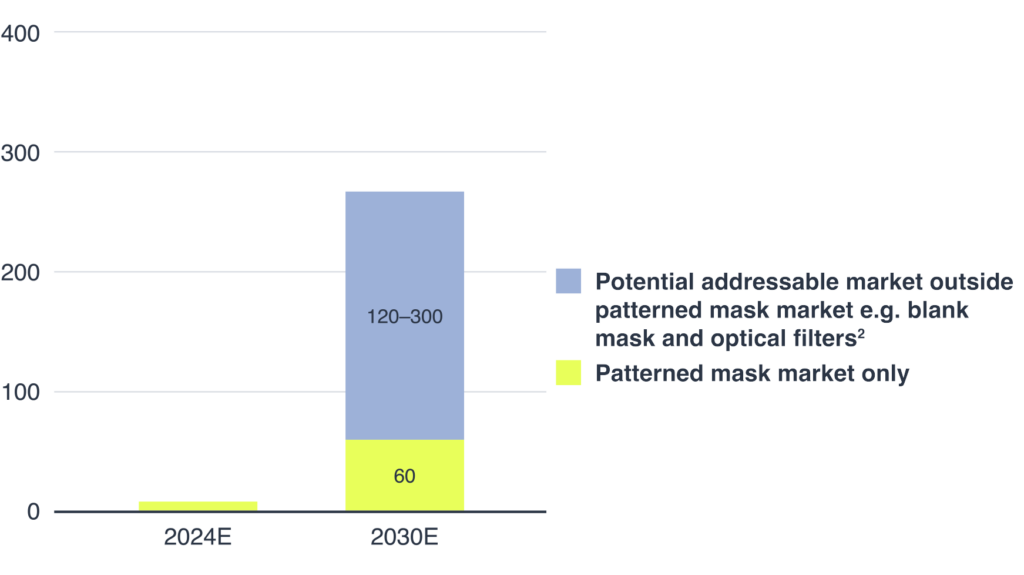
2) If inspection membranes would be used beyond patterned mask inspection, the other quality control phases are estimated to expand the inspection membrane market by 2-5x, resulting in a total market potential of approximately EUR 120-300m in 2030E;
Automotive market
The adoption of higher-level autonomous driving systems (ADAS) and the growth of battery electric vehicles (BEVs) are expected to drive increasing demand for reliable and efficient film heaters. Each stage of autonomous vehicle development requires a growing number of optical sensors with ever-higher optical performance requirements. At the same time, total energy optimization is becoming essential, with advanced
HVAC systems, localized heating to reduce thermal losses, and next-generation solar panels enabling independent energy generation for extended driving range.
Although hot wire heaters are currently the most widely used heating solution, certain performance requirements originating from ADAS suggest the need for alternatives. However, no mainstream replacement has been established yet.
According to a Gartner market report, SAE (Society of Automotive Engineers) Levels 2 and 2+ driving automation are expected to dominate in terms of volume in the mid-term. OEMs are increasingly adopting Level 2+ systems to enable hands-free driving experiences that offer strong consumer appeal while maintaining manageable costs, liability, and integration complexity. Based on Canatu management view, more OEMs in China are shifting toward primarily camera-based ADAS solutions, moving away from costlier sensor fusion systems. This shift is expected to drive greater demand for optically optimized and energyefficient film heaters, such as those developed by Canatu.
Automakers are advancing toward Level 3 driver assistance systems (conditional automation). BMW and Mercedes-Benz have already launched their systems in Germany. In February 2025, Stellantis announced that its Level 3 system is ready for rollout. Zeekr is currently testing its system, and XPeng plans to expand its XNGP platform across China. Honda is expected to introduce Level 3 capabilities in its Honda 0 series
later this year. However, multiple market studies note that L3 adoption remains limited relative to L2/L2+ due to liability and regulatory complexity. Canatu anticipates delays in Level 3 adoption due to the high cost of implementation and the slow pace of regulatory changes across different regions.
Despite slower adoption of L3, robotaxis (L4) are advancing rapidly. Waymo uses a sensor fusion approach (LiDAR, radar, cameras, mapping) for ADAS, while Tesla utilizes a “vision-only” ADAS camera approach. Waymo continues to deploy Level 4 autonomous robotaxis, requiring no human driver, in selected U.S. cities, including Phoenix, San Francisco, and Los Angeles, and expanded service to Miami in January 2026,
marking its sixth U.S. market. Level 4 testing continues in China with government support, though full commercialization is still several years away. In June 2025, Tesla launched a limited robotaxi service in Austin, Texas, initially with safety monitors onboard. By December 2025 Tesla began testing without a safety driver, and by January 2026 it started offering some public driverless rides in Austin. In February 2026, Waymo closed a US$16 billion funding round at a roughly US$110 billion valuation to accelerate U.S. and international expansion, underscoring investor confidence in autonomous ride-hailing.
Market size and growth, (EURm)
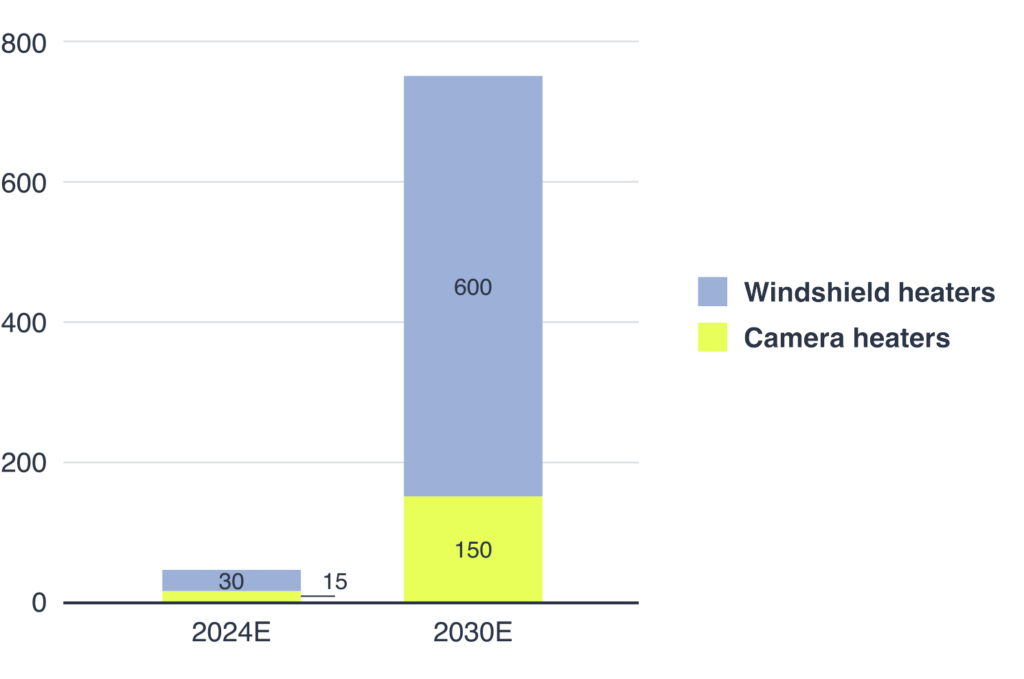
1) Canatu’s addressable automotive market includes Camera heaters and Windshield heaters (potential future extension for Canatu);
2) Estimations based on management’s view and on the Market Study
Medical diagnostics market
The medical diagnostics field is undergoing a significant transformation, shifting from traditional laboratory testing to more agile point-of-care (POC) solutions. This transition is driven by a growing demand for faster, more affordable, and convenient tests that can be performed at or near the site of patient care. Adopting these solutions leads to improved clinical outcomes, including reduced hospital stays, fewer unnecessary
admissions, and optimized operational efficiency for healthcare providers.
In this evolving landscape, Canatu is leveraging its highly sensitive electrochemical biosensors, which are built on proprietary CNT technology, to address new diagnostic needs. Recent publications have demonstrated the high sensitivity and performance of Canatu CNT technology, showing results equivalent to gold-standard centralized lab tests for detecting circulating tumor DNA and total testosterone.
Canatu has refined its strategy, with a focus on POC applications in the areas of hormone monitoring and infectious diseases. The company will also leverage key partnerships to enable a broader range of diagnostic applications, solidifying its role in the future of decentralized diagnostics.
The global market for POC applications in infectious diseases and hormone monitoring is estimated at USD 6 billion, with the U.S. market accounting for approximately USD 3.3 billion.