
What are carbon nanotubes and what are they used for?
Carbon nanotubes may be microscopic in size, but their potential to transform industries is immense. Carbon nanotubes are becoming increasingly common in the products and systems around us, thanks to ongoing advances in research and development and their wide range of applications. But what exactly are they, and how can they help build future solutions?
Carbon (C) is the fourth most abundant element in the universe. Its unique ability to form four covalent bonds makes it incredibly versatile, allowing for a wide range of molecular structures – from simple chains to complex 3D networks.
This bonding flexibility, combined with variations in atomic arrangement and environmental conditions, leads to the formation of multiple allotropes, such as graphite, diamond, graphene, and fullerenes, each with distinct properties. Carbon’s moderate reactivity and structural diversity make it the backbone of organic chemistry and a key player in advanced materials.
For example, the versatility of carbon forms the foundation of industries like pharmaceuticals and plastics and increasingly, in electronics, energy, and mobility. Advances in nanotechnology are beginning to reveal entirely new properties and possibilities in carbon-based materials – and this is only the beginning.
“At the nanoscale, we can enhance existing characteristics or unlock entirely new functionalities,” explains Ilkka Varjos, Chief Technology Officer at Canatu. “These innovations often lead to more energy-efficient solutions, helping reduce electricity consumption. Carbon-based components are typically lighter and require less material, which supports more compact, mobile, and sustainable technologies. Since carbon is abundant and widely available, it offers a practical path toward scalable, low-emission solutions for the future.”

The remarkable properties of carbon nanotubes make them ideal for advanced applications
Carbon nanotubes are a prime example of how carbon’s versatility translates into revolutionary applications in materials science, semiconductor technology, and beyond. Carbon nanotubes (CNTs) are tiny, tube-shaped materials made from carbon atoms. These tubes, a cylindrical form of graphene, are incredibly small – about 100,000 times thinner than a sheet of paper. Even though they are so small, they are extremely strong and have some amazing properties.
Carbon nanotubes are the strongest materials known, primarily due to two factors. First, their structure is held together by exceptionally strong carbon–carbon covalent bonds. Second, a nanotube is essentially a single seamless molecule, meaning it lacks the grain boundaries and structural discontinuities that weaken conventional materials like steel.
Carbon nanotubes have excellent optical properties. CNT films can be highly transparent, allowing most visible light to pass through with minimal reflection or haze. This makes them perfect for screens, sensors, and other devices where clear visibility is important. Even with such high transparency, the films still conduct electricity well, which is rare for see-through materials. Carbon nanotubes can remain stable at temperatures well beyond 1500 °C, especially in vacuum or inert environments, far surpassing most conventional materials.
Furthermore, CNT films are also flexible and stretchable. They can bend, twist, and even stretch to double their original length without breaking. This is because the nanotubes can slide and adjust under stress. Just like their strength, this flexibility comes from the unique structure of the nanotubes and the strong carbon bonds that hold them together.
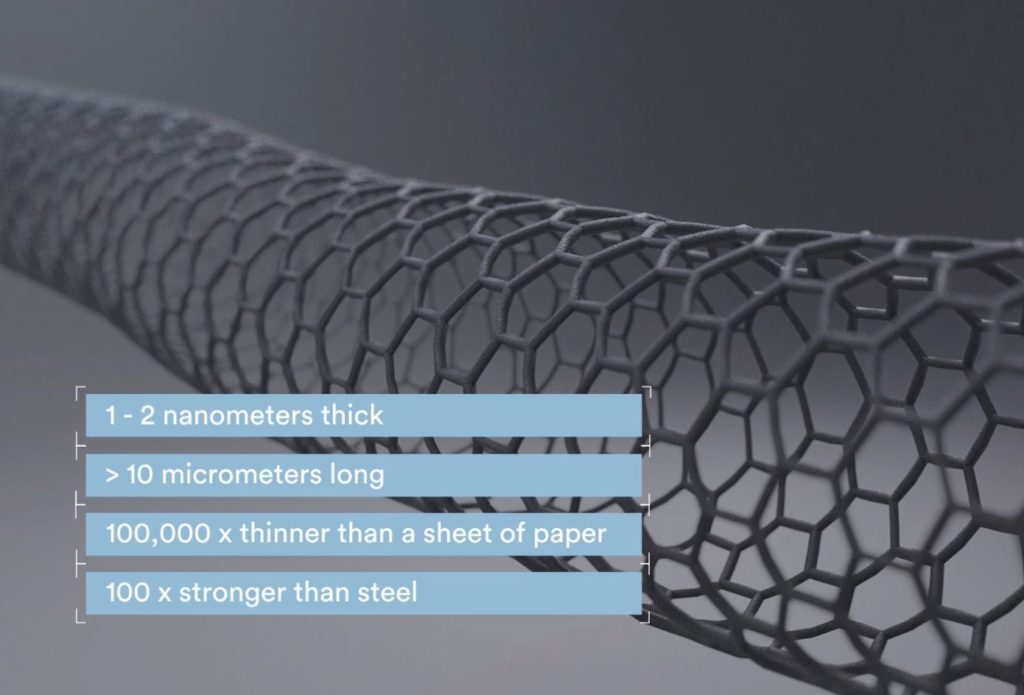
Carbon nanotube properties:
- Exceptional light transmission – CNT film networks offer outstanding optical properties with high transparency
- Very strong – 100 x stronger than steel, yet half as dense as aluminum
- Good conductors – Up to 1000x better electrical conductor than copper
- Flexible – They can bend repeatedly without cracking or wearing out
- Heat-resistant – thermally stable up to 1500°C
These special carbon nanotube properties make them useful in many areas of technology and science.
However, not all CNTs are the same,” says Varjos. “Their properties vary significantly depending on the carbon nanotube manufacturing method, leading to notable differences in quality. Broadly speaking, CNTs can be divided into bulk CNTs, produced in high volumes for lower-end applications, and advanced CNTs, which are manufactured in smaller quantities but offer the highest quality for demanding, engineered solutions.”
Carbon nanotube uses – from laboratory research to a building block of advanced engineering
The advancement of carbon nanotubes has followed a steep learning curve, accelerated by breakthroughs in nanotechnology and related fields. When first explored seriously about thirty years ago, CNT manufacturing was inconsistent. Various forms of nanotubes were produced unpredictably, limiting their use to basic applications.
Over time, laboratory research led to methods for producing specific types of nanotubes with reliable quality. This shift turned CNTs from a scientific novelty into a viable component for advanced engineering.
“Initially, carbon nanotubes were used in composite materials to strengthen or enhance existing products,” says Varjos. “The second wave of innovation is now enabling entirely new products with dramatically improved properties. Looking ahead, CNTs are expected to unlock applications that were previously out of reach, enabling breakthroughs once thought impossible.”
The automotive industry first adopted CNTs in minor ways, for example, replacing carbon black in plastic parts to prevent static buildup. Today, CNTs play a much more significant role. They are now part of cutting-edge developments that support autonomous driving, highlighting how far the technology has advanced.
In the semiconductor field, carbon nanotubes are already making their way into advanced manufacturing. CNT-based membranes are poised to be used in EUV (extreme ultraviolet) lithography machines, a critical technology for producing next-generation chips.
Looking ahead, CNTs also hold immense promise for future breakthroughs, such as carbon nanotube-based transistors. These could one day extend, or even reinvent Moore’s Law, powering the next wave of AI, connectivity, and digital transformation.
Driving carbon nanotube development through collaboration
As carbon nanotube technology advances and becomes more integrated into industrial applications, it’s increasingly important to lay the groundwork for responsible and consistent use. Establishing common standards across the industry is a key part of this effort, helping ensure the reliability, quality, and scalability of CNT-based products.
Collaboration across sectors, from research institutions to manufacturers and end users, is essential to achieving this. By working together, stakeholders can align on standards, share insights, and accelerate the adoption of CNT technologies.
One initiative supporting this development is the Veturi program, led by Canatu, which brings together key players across the ecosystem to drive innovation and standardization in the field.
Canatu is at the forefront of carbon nanotube development, creating advanced CNTs for industry-transforming products. We work with carbon at the molecular level to unlock its full potential, focusing on creating CNT materials, CNT-based products, and CNT reactors for the for the Semiconductor, Automotive, and Medical Diagnostics industries.
Link: Read more about Canatu’s products
Contact us